
Archives
now browsing by author
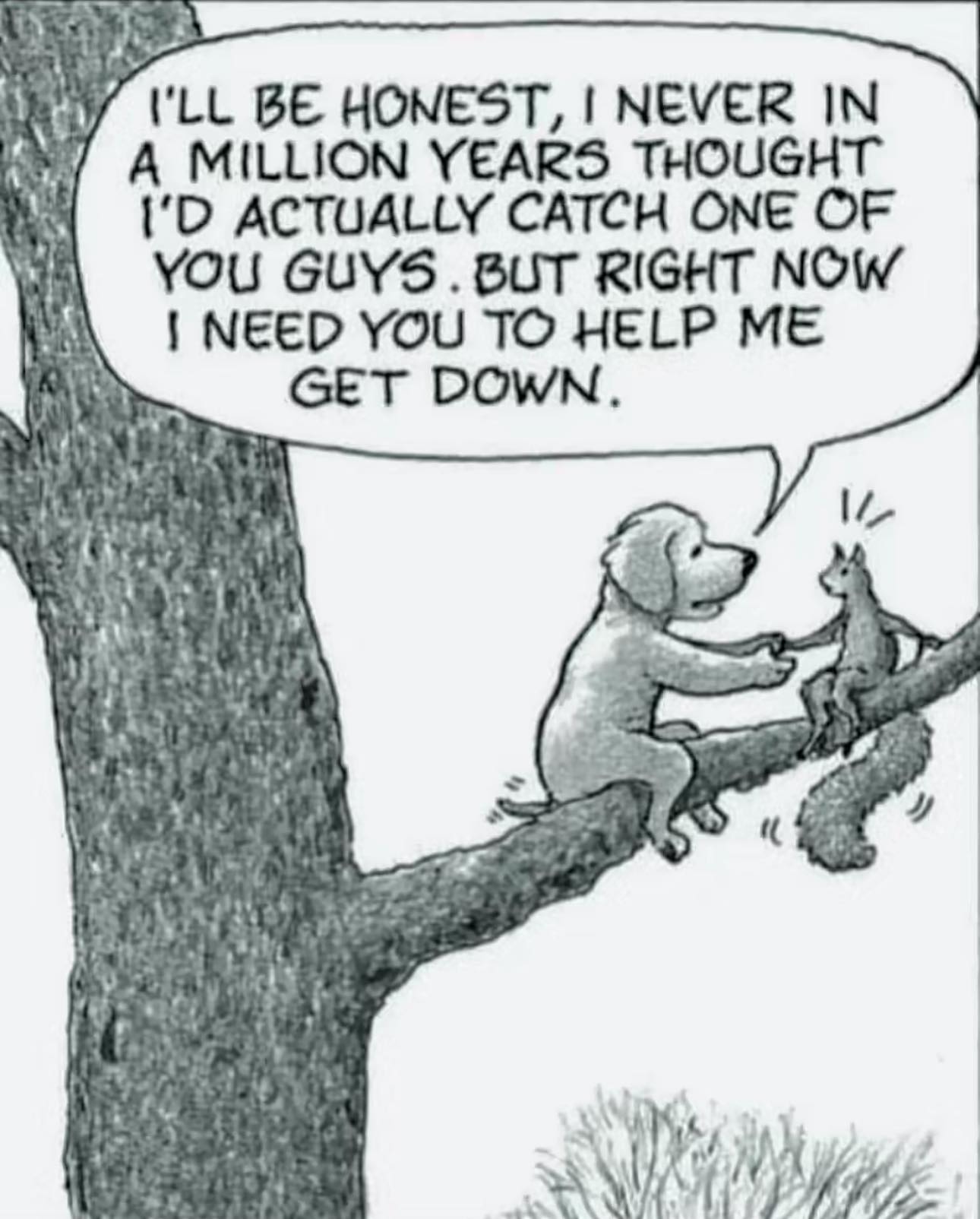
Squirrel – Lynn Ungar
Every day at the park
the dog goes mad chasing squirrels
that he will never catch. The busyness
of the squirrels is unending,
and so is his pursuit. He has no concern
for sense or safety, would gladly
follow his obsession
in front of an oncoming car.
And so every day we practice
coming back. I call his name,
and mostly, on a good day,
he circles gleefully around to me
before heading out again.
Every day, over and over,
that futile chase and the return.
Every day, a galloping dharma talk
on the discipline of calling out again
to my scattered mind,
to my grasping soul,
that it is time to come home.
Poetry
- A Dog Has Died – Pablo Neruda
- A Moment of Silence – Emmanuel Ortiz
- A Quiet Life – Baron Wormser
- A Wreath to the Fish – Nancy Willard
- Alone – Jack Gilbert
- Another Planet – Dunya Mikhail
- Be Kind, Rewind – Neil Silberblatt
- Black Momma Math – Kimberly Jae
- Boplicity or Jimmy Throws a Houseparty for Huey Newton – Daniel B. Summerhill
- Capitol Air – Allen Ginsburg
- Combat Primer – Charles Bukowski
- Crow Blacker Than Ever – Ted Hughes
- Dismiss Whatever Insults Your Own Soul – Walt Whitman
- Don’t fall in love with a woman who reads – Martha Rivera-Garrido
- Failing and Flying – Jack Gilbert
- Feel Mo – Michael Korson
- Footprints In Your Heart – Eleanor Roosvelt
- For Calling the Spirit Back from Wandering the Earth in Its Human Feet – Joy Harjo
- Forgetfulness – Billy Collins
- Growing Old – Emma Rosenberg
- Half-light – Dāshaun Washington
- Homesick: A Plea for Our Planet – Andrea Gibson
- How She Heard It – Todd Davis
- How to Slay a Dragon – Rebecca Dupas
- I Talked to a Lady – Tanya Howden
- If You Knew – Ellen Bass
- Instructions before visiting Earth – James McCrae
- KINDNESS – Naomi Shihab Nye
- Love is Not All – Edna St. Vincent Millay
- Men – Maya Angelou
- Millennium Blessing – Stephen Levine
- my brain and heart divorced ~ john roedel
- Ode to Those Who Block Tunnels and Bridges – Sam Sax
- Old Man Eating Alone – Billy Collins
- Relax – Ellen Bass
- Shoveling Snow With Buddha – Billy Collins
- Sleeping in the Forest – Mary Oliver
- Small Stack of Books – Blake Nelson
- Soliloquy of the Solipsist – Sylvia Plath
- Squirrel – Lynn Ungar
- Tangled Up In Blue – Bob Dylan
- The Caveman’s Lament – Brian Bilston
- The Four Noble Truths – Jake Onami Agnew
- The History of One Tough Motherfucker – Charles Bukowski
- The Layers – Stanley Kunitz
- The Long Boat – Stanley Kunitz
- The Moon is Full Tonight – Billy Collins
- The Shyness – Sharon Olds
- The War Works Hard – Dunya Mikhail
- The World is Both Burning and Blooming – Karen Salmansohn
- To Diego with Love – Frida Kalko
- Tryst with Death – Gina Puorro
- Two poems – Wendell Berry
- Two poems – Yehuda Amichai
- Two-bloods – Rolando Kattan
- Wage Peace – Mary Oliver
- War Primer – Bertholt Brecht
- We are the Trees – J Raymond
- We will meet, don’t be in such a rush – Hala alShrouf
- What I Learned From Listening to a Stutterer – Ellen Zorin
- Who Says Words With My Mouth? – Jalal ad-Din Rumi
We will meet, don’t be in such a rush – Hala alShrouf
In twenty thousand years, when the dust settles on this earth
and the despair, and
its fires burn out, and it recovers from horrors that today seem endless,
and the planet returns to what it was twenty millennia ago—
green with blue water, and white clouds always—
then we will meet.
We will arrive as we did the first time:
without shields, without weapons,
eyes open to the soul,
whose question is a key,
whose answer is a haven,
whose language travels—like waves of light on ether—the distance between us,
beyond speech.
We’re going to need that time. Perhaps more.
For the volcanoes to cool,
and lamps to light the first, second, and third skies,
for the trees to reform into forests extending in all directions,
for light rays to return to their source—gold’s and silver’s light—and you and I:
You will see me and fall into my arms.
I will see you and fall into your arms.
West Bank, 2023

Poetry
- A Dog Has Died – Pablo Neruda
- A Moment of Silence – Emmanuel Ortiz
- A Quiet Life – Baron Wormser
- A Wreath to the Fish – Nancy Willard
- Alone – Jack Gilbert
- Another Planet – Dunya Mikhail
- Be Kind, Rewind – Neil Silberblatt
- Black Momma Math – Kimberly Jae
- Boplicity or Jimmy Throws a Houseparty for Huey Newton – Daniel B. Summerhill
- Capitol Air – Allen Ginsburg
- Combat Primer – Charles Bukowski
- Crow Blacker Than Ever – Ted Hughes
- Dismiss Whatever Insults Your Own Soul – Walt Whitman
- Don’t fall in love with a woman who reads – Martha Rivera-Garrido
- Failing and Flying – Jack Gilbert
- Feel Mo – Michael Korson
- Footprints In Your Heart – Eleanor Roosvelt
- For Calling the Spirit Back from Wandering the Earth in Its Human Feet – Joy Harjo
- Forgetfulness – Billy Collins
- Growing Old – Emma Rosenberg
- Half-light – Dāshaun Washington
- Homesick: A Plea for Our Planet – Andrea Gibson
- How She Heard It – Todd Davis
- How to Slay a Dragon – Rebecca Dupas
- I Talked to a Lady – Tanya Howden
- If You Knew – Ellen Bass
- Instructions before visiting Earth – James McCrae
- KINDNESS – Naomi Shihab Nye
- Love is Not All – Edna St. Vincent Millay
- Men – Maya Angelou
- Millennium Blessing – Stephen Levine
- my brain and heart divorced ~ john roedel
- Ode to Those Who Block Tunnels and Bridges – Sam Sax
- Old Man Eating Alone – Billy Collins
- Relax – Ellen Bass
- Shoveling Snow With Buddha – Billy Collins
- Sleeping in the Forest – Mary Oliver
- Small Stack of Books – Blake Nelson
- Soliloquy of the Solipsist – Sylvia Plath
- Squirrel – Lynn Ungar
- Tangled Up In Blue – Bob Dylan
- The Caveman’s Lament – Brian Bilston
- The Four Noble Truths – Jake Onami Agnew
- The History of One Tough Motherfucker – Charles Bukowski
- The Layers – Stanley Kunitz
- The Long Boat – Stanley Kunitz
- The Moon is Full Tonight – Billy Collins
- The Shyness – Sharon Olds
- The War Works Hard – Dunya Mikhail
- The World is Both Burning and Blooming – Karen Salmansohn
- To Diego with Love – Frida Kalko
- Tryst with Death – Gina Puorro
- Two poems – Wendell Berry
- Two poems – Yehuda Amichai
- Two-bloods – Rolando Kattan
- Wage Peace – Mary Oliver
- War Primer – Bertholt Brecht
- We are the Trees – J Raymond
- We will meet, don’t be in such a rush – Hala alShrouf
- What I Learned From Listening to a Stutterer – Ellen Zorin
- Who Says Words With My Mouth? – Jalal ad-Din Rumi
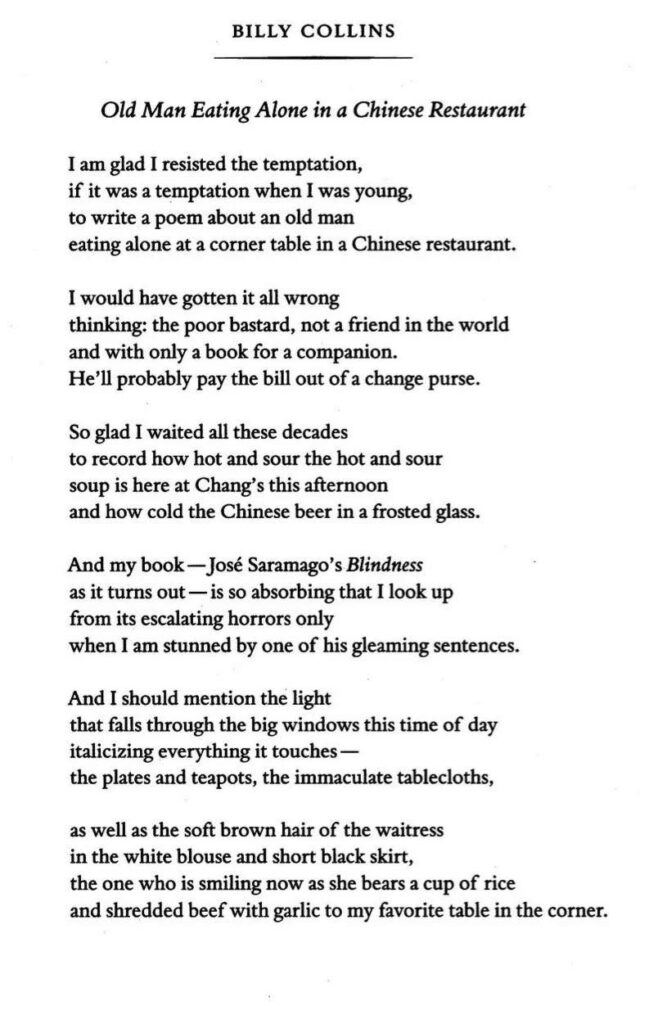
Old Man Eating Alone – Billy Collins

Poetry
- A Dog Has Died – Pablo Neruda
- A Moment of Silence – Emmanuel Ortiz
- A Quiet Life – Baron Wormser
- A Wreath to the Fish – Nancy Willard
- Alone – Jack Gilbert
- Another Planet – Dunya Mikhail
- Be Kind, Rewind – Neil Silberblatt
- Black Momma Math – Kimberly Jae
- Boplicity or Jimmy Throws a Houseparty for Huey Newton – Daniel B. Summerhill
- Capitol Air – Allen Ginsburg
- Combat Primer – Charles Bukowski
- Crow Blacker Than Ever – Ted Hughes
- Dismiss Whatever Insults Your Own Soul – Walt Whitman
- Don’t fall in love with a woman who reads – Martha Rivera-Garrido
- Failing and Flying – Jack Gilbert
- Feel Mo – Michael Korson
- Footprints In Your Heart – Eleanor Roosvelt
- For Calling the Spirit Back from Wandering the Earth in Its Human Feet – Joy Harjo
- Forgetfulness – Billy Collins
- Growing Old – Emma Rosenberg
- Half-light – Dāshaun Washington
- Homesick: A Plea for Our Planet – Andrea Gibson
- How She Heard It – Todd Davis
- How to Slay a Dragon – Rebecca Dupas
- I Talked to a Lady – Tanya Howden
- If You Knew – Ellen Bass
- Instructions before visiting Earth – James McCrae
- KINDNESS – Naomi Shihab Nye
- Love is Not All – Edna St. Vincent Millay
- Men – Maya Angelou
- Millennium Blessing – Stephen Levine
- my brain and heart divorced ~ john roedel
- Ode to Those Who Block Tunnels and Bridges – Sam Sax
- Old Man Eating Alone – Billy Collins
- Relax – Ellen Bass
- Shoveling Snow With Buddha – Billy Collins
- Sleeping in the Forest – Mary Oliver
- Small Stack of Books – Blake Nelson
- Soliloquy of the Solipsist – Sylvia Plath
- Squirrel – Lynn Ungar
- Tangled Up In Blue – Bob Dylan
- The Caveman’s Lament – Brian Bilston
- The Four Noble Truths – Jake Onami Agnew
- The History of One Tough Motherfucker – Charles Bukowski
- The Layers – Stanley Kunitz
- The Long Boat – Stanley Kunitz
- The Moon is Full Tonight – Billy Collins
- The Shyness – Sharon Olds
- The War Works Hard – Dunya Mikhail
- The World is Both Burning and Blooming – Karen Salmansohn
- To Diego with Love – Frida Kalko
- Tryst with Death – Gina Puorro
- Two poems – Wendell Berry
- Two poems – Yehuda Amichai
- Two-bloods – Rolando Kattan
- Wage Peace – Mary Oliver
- War Primer – Bertholt Brecht
- We are the Trees – J Raymond
- We will meet, don’t be in such a rush – Hala alShrouf
- What I Learned From Listening to a Stutterer – Ellen Zorin
- Who Says Words With My Mouth? – Jalal ad-Din Rumi
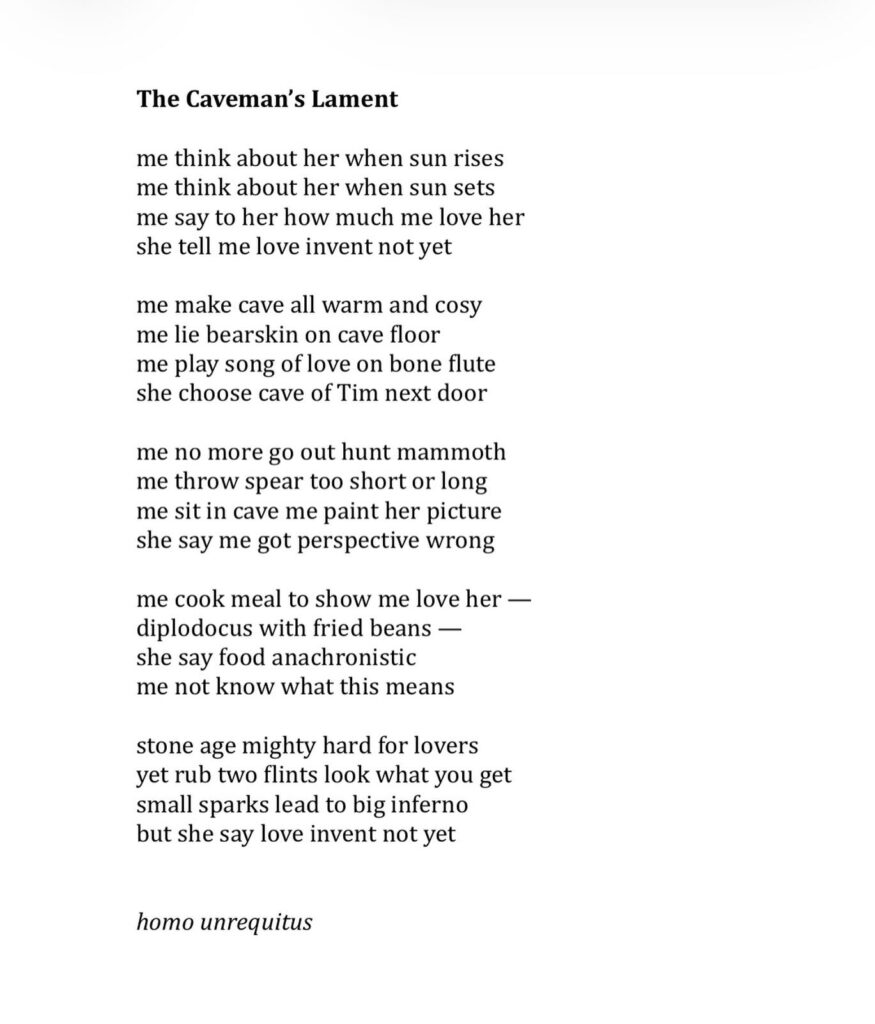
The Caveman’s Lament – Brian Bilston

Poetry
- A Dog Has Died – Pablo Neruda
- A Moment of Silence – Emmanuel Ortiz
- A Quiet Life – Baron Wormser
- A Wreath to the Fish – Nancy Willard
- Alone – Jack Gilbert
- Another Planet – Dunya Mikhail
- Be Kind, Rewind – Neil Silberblatt
- Black Momma Math – Kimberly Jae
- Boplicity or Jimmy Throws a Houseparty for Huey Newton – Daniel B. Summerhill
- Capitol Air – Allen Ginsburg
- Combat Primer – Charles Bukowski
- Crow Blacker Than Ever – Ted Hughes
- Dismiss Whatever Insults Your Own Soul – Walt Whitman
- Don’t fall in love with a woman who reads – Martha Rivera-Garrido
- Failing and Flying – Jack Gilbert
- Feel Mo – Michael Korson
- Footprints In Your Heart – Eleanor Roosvelt
- For Calling the Spirit Back from Wandering the Earth in Its Human Feet – Joy Harjo
- Forgetfulness – Billy Collins
- Growing Old – Emma Rosenberg
- Half-light – Dāshaun Washington
- Homesick: A Plea for Our Planet – Andrea Gibson
- How She Heard It – Todd Davis
- How to Slay a Dragon – Rebecca Dupas
- I Talked to a Lady – Tanya Howden
- If You Knew – Ellen Bass
- Instructions before visiting Earth – James McCrae
- KINDNESS – Naomi Shihab Nye
- Love is Not All – Edna St. Vincent Millay
- Men – Maya Angelou
- Millennium Blessing – Stephen Levine
- my brain and heart divorced ~ john roedel
- Ode to Those Who Block Tunnels and Bridges – Sam Sax
- Old Man Eating Alone – Billy Collins
- Relax – Ellen Bass
- Shoveling Snow With Buddha – Billy Collins
- Sleeping in the Forest – Mary Oliver
- Small Stack of Books – Blake Nelson
- Soliloquy of the Solipsist – Sylvia Plath
- Squirrel – Lynn Ungar
- Tangled Up In Blue – Bob Dylan
- The Caveman’s Lament – Brian Bilston
- The Four Noble Truths – Jake Onami Agnew
- The History of One Tough Motherfucker – Charles Bukowski
- The Layers – Stanley Kunitz
- The Long Boat – Stanley Kunitz
- The Moon is Full Tonight – Billy Collins
- The Shyness – Sharon Olds
- The War Works Hard – Dunya Mikhail
- The World is Both Burning and Blooming – Karen Salmansohn
- To Diego with Love – Frida Kalko
- Tryst with Death – Gina Puorro
- Two poems – Wendell Berry
- Two poems – Yehuda Amichai
- Two-bloods – Rolando Kattan
- Wage Peace – Mary Oliver
- War Primer – Bertholt Brecht
- We are the Trees – J Raymond
- We will meet, don’t be in such a rush – Hala alShrouf
- What I Learned From Listening to a Stutterer – Ellen Zorin
- Who Says Words With My Mouth? – Jalal ad-Din Rumi
Half-light – Dāshaun Washington
God said Let there be light
and we stood before the sun
shed the daylight from our selves
and donned dusk
God said Let there be light
and a moth emerged
from my molasses-black chrysalis
God said Let there be light
and we became
our blackest selves
God said Let there be light
and we became our own gods
God said Let there be light
and from the shade we watched
the sky shine her brightest
Let there be light
and day became
seemingly so
Let there be light
and night was never so black
Let there be light
and flesh became skin
and skin became colored
and the light was let in the house
and the cotton rose in the fields
and the master’s tools took shape
and an ocean kept us apart
and the indigo washed the coastline
and blue-black hands worked their fingers to the bone
and the rivers teemed with teeth
and barks ran through the woods
and the days grew darker
and the heavens rose beyond our reach
and God’s absence became apparent
and smoke poured over the mountain’s edge
and the fields filled with fire
and there was light
“This poem is the result of my interrogation of God’s role in the inhumanities of the world He supposedly created, specifically the dehumanization of Black people [which] laid the foundation for the transatlantic slave trade.” Dāshaun Washington
Poetry
- A Dog Has Died – Pablo Neruda
- A Moment of Silence – Emmanuel Ortiz
- A Quiet Life – Baron Wormser
- A Wreath to the Fish – Nancy Willard
- Alone – Jack Gilbert
- Another Planet – Dunya Mikhail
- Be Kind, Rewind – Neil Silberblatt
- Black Momma Math – Kimberly Jae
- Boplicity or Jimmy Throws a Houseparty for Huey Newton – Daniel B. Summerhill
- Capitol Air – Allen Ginsburg
- Combat Primer – Charles Bukowski
- Crow Blacker Than Ever – Ted Hughes
- Dismiss Whatever Insults Your Own Soul – Walt Whitman
- Don’t fall in love with a woman who reads – Martha Rivera-Garrido
- Failing and Flying – Jack Gilbert
- Feel Mo – Michael Korson
- Footprints In Your Heart – Eleanor Roosvelt
- For Calling the Spirit Back from Wandering the Earth in Its Human Feet – Joy Harjo
- Forgetfulness – Billy Collins
- Growing Old – Emma Rosenberg
- Half-light – Dāshaun Washington
- Homesick: A Plea for Our Planet – Andrea Gibson
- How She Heard It – Todd Davis
- How to Slay a Dragon – Rebecca Dupas
- I Talked to a Lady – Tanya Howden
- If You Knew – Ellen Bass
- Instructions before visiting Earth – James McCrae
- KINDNESS – Naomi Shihab Nye
- Love is Not All – Edna St. Vincent Millay
- Men – Maya Angelou
- Millennium Blessing – Stephen Levine
- my brain and heart divorced ~ john roedel
- Ode to Those Who Block Tunnels and Bridges – Sam Sax
- Old Man Eating Alone – Billy Collins
- Relax – Ellen Bass
- Shoveling Snow With Buddha – Billy Collins
- Sleeping in the Forest – Mary Oliver
- Small Stack of Books – Blake Nelson
- Soliloquy of the Solipsist – Sylvia Plath
- Squirrel – Lynn Ungar
- Tangled Up In Blue – Bob Dylan
- The Caveman’s Lament – Brian Bilston
- The Four Noble Truths – Jake Onami Agnew
- The History of One Tough Motherfucker – Charles Bukowski
- The Layers – Stanley Kunitz
- The Long Boat – Stanley Kunitz
- The Moon is Full Tonight – Billy Collins
- The Shyness – Sharon Olds
- The War Works Hard – Dunya Mikhail
- The World is Both Burning and Blooming – Karen Salmansohn
- To Diego with Love – Frida Kalko
- Tryst with Death – Gina Puorro
- Two poems – Wendell Berry
- Two poems – Yehuda Amichai
- Two-bloods – Rolando Kattan
- Wage Peace – Mary Oliver
- War Primer – Bertholt Brecht
- We are the Trees – J Raymond
- We will meet, don’t be in such a rush – Hala alShrouf
- What I Learned From Listening to a Stutterer – Ellen Zorin
- Who Says Words With My Mouth? – Jalal ad-Din Rumi
The Moon is Full Tonight – Billy Collins
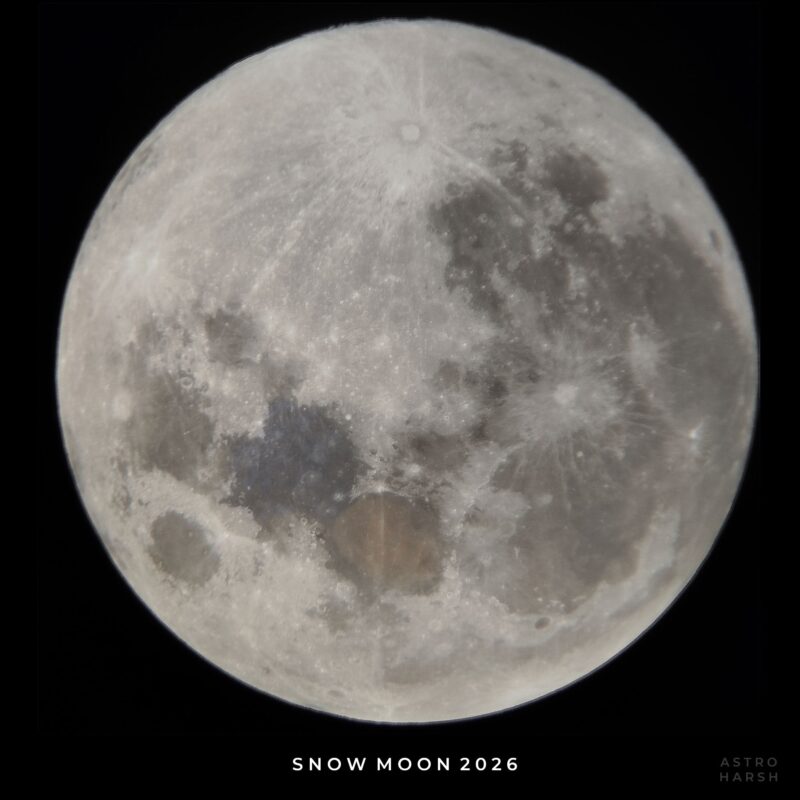
The moon is full tonight ….
It’s as full as it was
in that poem by Coleridge
where he carries his year-old son
into the orchard behind the cottage
and turns the baby’s face to the sky
to see for the first time
the earth’s bright companion,
something amazing to make his crying seem small.
And if you wanted to follow this example,
tonight would be the night
to carry some tiny creature outside
and introduce him to the moon.
And if your house has no child,
you can always gather into your arms
the sleeping infant of yourself,
as I have done tonight,
and carry him outdoors,
all limp in his tattered blanket,
making sure to steady his lolling head
with the palm of your hand.
And while the wind ruffles the pear trees
in the corner of the orchard
and dark roses wave against a stone wall,
you can turn him on your shoulder
and walk in circles on the lawn
drunk with the light.
You can lift him up into the sky,
your eyes nearly as wide as his,
as the moon climbs high into the night.
Poetry
- A Dog Has Died – Pablo Neruda
- A Moment of Silence – Emmanuel Ortiz
- A Quiet Life – Baron Wormser
- A Wreath to the Fish – Nancy Willard
- Alone – Jack Gilbert
- Another Planet – Dunya Mikhail
- Be Kind, Rewind – Neil Silberblatt
- Black Momma Math – Kimberly Jae
- Boplicity or Jimmy Throws a Houseparty for Huey Newton – Daniel B. Summerhill
- Capitol Air – Allen Ginsburg
- Combat Primer – Charles Bukowski
- Crow Blacker Than Ever – Ted Hughes
- Dismiss Whatever Insults Your Own Soul – Walt Whitman
- Don’t fall in love with a woman who reads – Martha Rivera-Garrido
- Failing and Flying – Jack Gilbert
- Feel Mo – Michael Korson
- Footprints In Your Heart – Eleanor Roosvelt
- For Calling the Spirit Back from Wandering the Earth in Its Human Feet – Joy Harjo
- Forgetfulness – Billy Collins
- Growing Old – Emma Rosenberg
- Half-light – Dāshaun Washington
- Homesick: A Plea for Our Planet – Andrea Gibson
- How She Heard It – Todd Davis
- How to Slay a Dragon – Rebecca Dupas
- I Talked to a Lady – Tanya Howden
- If You Knew – Ellen Bass
- Instructions before visiting Earth – James McCrae
- KINDNESS – Naomi Shihab Nye
- Love is Not All – Edna St. Vincent Millay
- Men – Maya Angelou
- Millennium Blessing – Stephen Levine
- my brain and heart divorced ~ john roedel
- Ode to Those Who Block Tunnels and Bridges – Sam Sax
- Old Man Eating Alone – Billy Collins
- Relax – Ellen Bass
- Shoveling Snow With Buddha – Billy Collins
- Sleeping in the Forest – Mary Oliver
- Small Stack of Books – Blake Nelson
- Soliloquy of the Solipsist – Sylvia Plath
- Squirrel – Lynn Ungar
- Tangled Up In Blue – Bob Dylan
- The Caveman’s Lament – Brian Bilston
- The Four Noble Truths – Jake Onami Agnew
- The History of One Tough Motherfucker – Charles Bukowski
- The Layers – Stanley Kunitz
- The Long Boat – Stanley Kunitz
- The Moon is Full Tonight – Billy Collins
- The Shyness – Sharon Olds
- The War Works Hard – Dunya Mikhail
- The World is Both Burning and Blooming – Karen Salmansohn
- To Diego with Love – Frida Kalko
- Tryst with Death – Gina Puorro
- Two poems – Wendell Berry
- Two poems – Yehuda Amichai
- Two-bloods – Rolando Kattan
- Wage Peace – Mary Oliver
- War Primer – Bertholt Brecht
- We are the Trees – J Raymond
- We will meet, don’t be in such a rush – Hala alShrouf
- What I Learned From Listening to a Stutterer – Ellen Zorin
- Who Says Words With My Mouth? – Jalal ad-Din Rumi
Trials
This is what it’s about. The clients are all guilty. The possibility of plea negotiations are non-existent because the penalties are as severe with a plea as with a guilty verdict. There is nothing to lose by trying the case except the case. I know the clients don’t stand a chance. I tell them so. It will be exclusively the police’s word against their word, more often, against their silence. The jurors listen. Cracks appear in the government’s case. Testimony is shown to be inconsistent. There are gaps in the story. Areas of interpretation, perhaps even doubt, begin to appear. At final argument I tell the jurors, “look, ladies and gentlemen, maybe the defendant did do what the government alleges he did, but ‘maybe’ isn’t enough, even ‘more probably than not’ is not enough. Ladies and gentlemen, the government must prove that this good person on trial did “x,” “y,” and “z.” And must prove that the defendant committed each and every element of the crime charged, beyond a reasonable doubt. And there are certain reasonable doubts, which I suggest you might consider in your deliberations. And not only that, but the government must also prove the defendant’s knowledge, and the defendant’s intent. And they must prove that knowledge and intent beyond a reasonable doubt, etc.” And in most criminal trials, by the end I am believing my own story. And I have reasonable doubts, or at least they seem reasonable to me. And the jury comes back with a question. And you know they’re struggling with the case, attempting to grapple with their doubts and their differences. And the court officers and the clerks tell you what a smashing wonderful job you did and how you just might have snatched victory out of the jaws of defeat. And against all your better judgment and experience you start to say maybe, just maybe, the verdict will be not guilty. Why in point of fact, it almost has to be not guilty. And then the jury returns. And they’re not looking at you. And the foreperson is asked, “what say you, madam foreperson, is the defendant guilty of not guilty?” And the forelady says, “Guilty.” “And thus say you too ladies and gentlemen of the jury?” And the jurors all nod their assent, and the judge gives them a little speech about duty and freedom, and some of the ladies cry, and the jurors file out, and the government moves for sentencing, and the judge politely listens to your arguments, and the client shakes your hand, and you say, “sorry, man,” and the guy says, “you did the best you could,” and looks you in the eye, bravely or stunned, and is placed in handcuffs and led off to jail.
Am I doing something wrong? Trying too hard with jurors who know they’re being sold a line by me? Just on the wrong side of the case? Trying to see that justice is done. Not sure what is just.
LAW STORIES
- [Template] Law Stories
- 001 – Telephone
- 002 – Yvonne
- 003 – My offices
- 004 – One of those Days
- 005 – Bail
- 006 – The Suffolk County Courthouse
- 007 – Confession
- 008 – Not Johnny Cochran
- 009 – The Columbian Woman
- 010 – Samuel
- 011 – Met State
- 012 – Adversarial Relations
- 013 – Her Scream
- A Friend Named Jan
- Closing Argument
- Cop
- Eddie V.
- Eddie’s Bust
- Gainey
- Her Calls
- Her Grandfather
- Her View
- Hitting Louie
- Mark
- Meeting Drew
- Our Case is Called
- Partners
- Phone Call
- The House of Cohen
- Trials

KINDNESS – Naomi Shihab Nye
Before you know what kindness really is
you must lose things,
feel the future dissolve in a moment
like salt in a weakened broth.
What you held in your hand,
what you counted and carefully saved,
all this must go so you know
how desolate the landscape can be
between the regions of kindness.
How you ride and ride
thinking the bus will never stop,
the passengers eating maize and chicken
will stare out the window forever.
Before you learn the tender gravity of kindness
you must travel where the Indian in a white poncho
lies dead by the side of the road.
You must see how this could be you,
how he too was someone
who journeyed through the night with plans
and the simple breath that kept him alive.
Before you know kindness as the deepest thing inside,
you must know sorrow as the other deepest thing.
You must wake up with sorrow.
You must speak to it till your voice
catches the thread of all sorrows
and you see the size of the cloth.
Then it is only kindness that makes sense anymore,
only kindness that ties your shoes
and sends you out into the day to gaze at bread,
only kindness that raises its head
from the crowd of the world to say
It is I you have been looking f
and then goes with you everywhere
like a shadow or a friend.

Poetry
- A Dog Has Died – Pablo Neruda
- A Moment of Silence – Emmanuel Ortiz
- A Quiet Life – Baron Wormser
- A Wreath to the Fish – Nancy Willard
- Alone – Jack Gilbert
- Another Planet – Dunya Mikhail
- Be Kind, Rewind – Neil Silberblatt
- Black Momma Math – Kimberly Jae
- Boplicity or Jimmy Throws a Houseparty for Huey Newton – Daniel B. Summerhill
- Capitol Air – Allen Ginsburg
- Combat Primer – Charles Bukowski
- Crow Blacker Than Ever – Ted Hughes
- Dismiss Whatever Insults Your Own Soul – Walt Whitman
- Don’t fall in love with a woman who reads – Martha Rivera-Garrido
- Failing and Flying – Jack Gilbert
- Feel Mo – Michael Korson
- Footprints In Your Heart – Eleanor Roosvelt
- For Calling the Spirit Back from Wandering the Earth in Its Human Feet – Joy Harjo
- Forgetfulness – Billy Collins
- Growing Old – Emma Rosenberg
- Half-light – Dāshaun Washington
- Homesick: A Plea for Our Planet – Andrea Gibson
- How She Heard It – Todd Davis
- How to Slay a Dragon – Rebecca Dupas
- I Talked to a Lady – Tanya Howden
- If You Knew – Ellen Bass
- Instructions before visiting Earth – James McCrae
- KINDNESS – Naomi Shihab Nye
- Love is Not All – Edna St. Vincent Millay
- Men – Maya Angelou
- Millennium Blessing – Stephen Levine
- my brain and heart divorced ~ john roedel
- Ode to Those Who Block Tunnels and Bridges – Sam Sax
- Old Man Eating Alone – Billy Collins
- Relax – Ellen Bass
- Shoveling Snow With Buddha – Billy Collins
- Sleeping in the Forest – Mary Oliver
- Small Stack of Books – Blake Nelson
- Soliloquy of the Solipsist – Sylvia Plath
- Squirrel – Lynn Ungar
- Tangled Up In Blue – Bob Dylan
- The Caveman’s Lament – Brian Bilston
- The Four Noble Truths – Jake Onami Agnew
- The History of One Tough Motherfucker – Charles Bukowski
- The Layers – Stanley Kunitz
- The Long Boat – Stanley Kunitz
- The Moon is Full Tonight – Billy Collins
- The Shyness – Sharon Olds
- The War Works Hard – Dunya Mikhail
- The World is Both Burning and Blooming – Karen Salmansohn
- To Diego with Love – Frida Kalko
- Tryst with Death – Gina Puorro
- Two poems – Wendell Berry
- Two poems – Yehuda Amichai
- Two-bloods – Rolando Kattan
- Wage Peace – Mary Oliver
- War Primer – Bertholt Brecht
- We are the Trees – J Raymond
- We will meet, don’t be in such a rush – Hala alShrouf
- What I Learned From Listening to a Stutterer – Ellen Zorin
- Who Says Words With My Mouth? – Jalal ad-Din Rumi
Shoveling Snow With Buddha – Billy Collins
In the usual iconography of the temple or the local Wok
you would never see him doing such a thing,
tossing the dry snow over a mountain
of his bare, round shoulder,
his hair tied in a knot,
a model of concentration.
Sitting is more his speed, if that is the word
for what he does, or does not do.
Even the season is wrong for him.
In all his manifestations, is it not warm or slightly humid?
Is this not implied by his serene expression,
that smile so wide it wraps itself around the waist of the universe?
But here we are, working our way down the driveway,
one shovelful at a time.
We toss the light powder into the clear air.
We feel the cold mist on our faces.
And with every heave we disappear
and become lost to each other
in these sudden clouds of our own making,
these fountain-bursts of snow.
This is so much better than a sermon in church,
I say out loud, but Buddha keeps on shoveling.
This is the true religion, the religion of snow,
and sunlight and winter geese barking in the sky,
I say, but he is too busy to hear me.
He has thrown himself into shoveling snow
as if it were the purpose of existence,
as if the sign of a perfect life were a clear driveway
you could back the car down easily
and drive off into the vanities of the world
with a broken heater fan and a song on the radio.
All morning long we work side by side,
me with my commentary
and he inside his generous pocket of silence,
until the hour is nearly noon
and the snow is piled high all around us;
then, I hear him speak.
After this, he asks,
can we go inside and play cards?
Certainly, I reply, and I will heat some milk
and bring cups of hot chocolate to the table
while you shuffle the deck.
and our boots stand dripping by the door.
Aaah, says the Buddha, lifting his eyes
and leaning for a moment on his shovel
before he drives the thin blade again
deep into the glittering white snow.

Poetry
- A Dog Has Died – Pablo Neruda
- A Moment of Silence – Emmanuel Ortiz
- A Quiet Life – Baron Wormser
- A Wreath to the Fish – Nancy Willard
- Alone – Jack Gilbert
- Another Planet – Dunya Mikhail
- Be Kind, Rewind – Neil Silberblatt
- Black Momma Math – Kimberly Jae
- Boplicity or Jimmy Throws a Houseparty for Huey Newton – Daniel B. Summerhill
- Capitol Air – Allen Ginsburg
- Combat Primer – Charles Bukowski
- Crow Blacker Than Ever – Ted Hughes
- Dismiss Whatever Insults Your Own Soul – Walt Whitman
- Don’t fall in love with a woman who reads – Martha Rivera-Garrido
- Failing and Flying – Jack Gilbert
- Feel Mo – Michael Korson
- Footprints In Your Heart – Eleanor Roosvelt
- For Calling the Spirit Back from Wandering the Earth in Its Human Feet – Joy Harjo
- Forgetfulness – Billy Collins
- Growing Old – Emma Rosenberg
- Half-light – Dāshaun Washington
- Homesick: A Plea for Our Planet – Andrea Gibson
- How She Heard It – Todd Davis
- How to Slay a Dragon – Rebecca Dupas
- I Talked to a Lady – Tanya Howden
- If You Knew – Ellen Bass
- Instructions before visiting Earth – James McCrae
- KINDNESS – Naomi Shihab Nye
- Love is Not All – Edna St. Vincent Millay
- Men – Maya Angelou
- Millennium Blessing – Stephen Levine
- my brain and heart divorced ~ john roedel
- Ode to Those Who Block Tunnels and Bridges – Sam Sax
- Old Man Eating Alone – Billy Collins
- Relax – Ellen Bass
- Shoveling Snow With Buddha – Billy Collins
- Sleeping in the Forest – Mary Oliver
- Small Stack of Books – Blake Nelson
- Soliloquy of the Solipsist – Sylvia Plath
- Squirrel – Lynn Ungar
- Tangled Up In Blue – Bob Dylan
- The Caveman’s Lament – Brian Bilston
- The Four Noble Truths – Jake Onami Agnew
- The History of One Tough Motherfucker – Charles Bukowski
- The Layers – Stanley Kunitz
- The Long Boat – Stanley Kunitz
- The Moon is Full Tonight – Billy Collins
- The Shyness – Sharon Olds
- The War Works Hard – Dunya Mikhail
- The World is Both Burning and Blooming – Karen Salmansohn
- To Diego with Love – Frida Kalko
- Tryst with Death – Gina Puorro
- Two poems – Wendell Berry
- Two poems – Yehuda Amichai
- Two-bloods – Rolando Kattan
- Wage Peace – Mary Oliver
- War Primer – Bertholt Brecht
- We are the Trees – J Raymond
- We will meet, don’t be in such a rush – Hala alShrouf
- What I Learned From Listening to a Stutterer – Ellen Zorin
- Who Says Words With My Mouth? – Jalal ad-Din Rumi
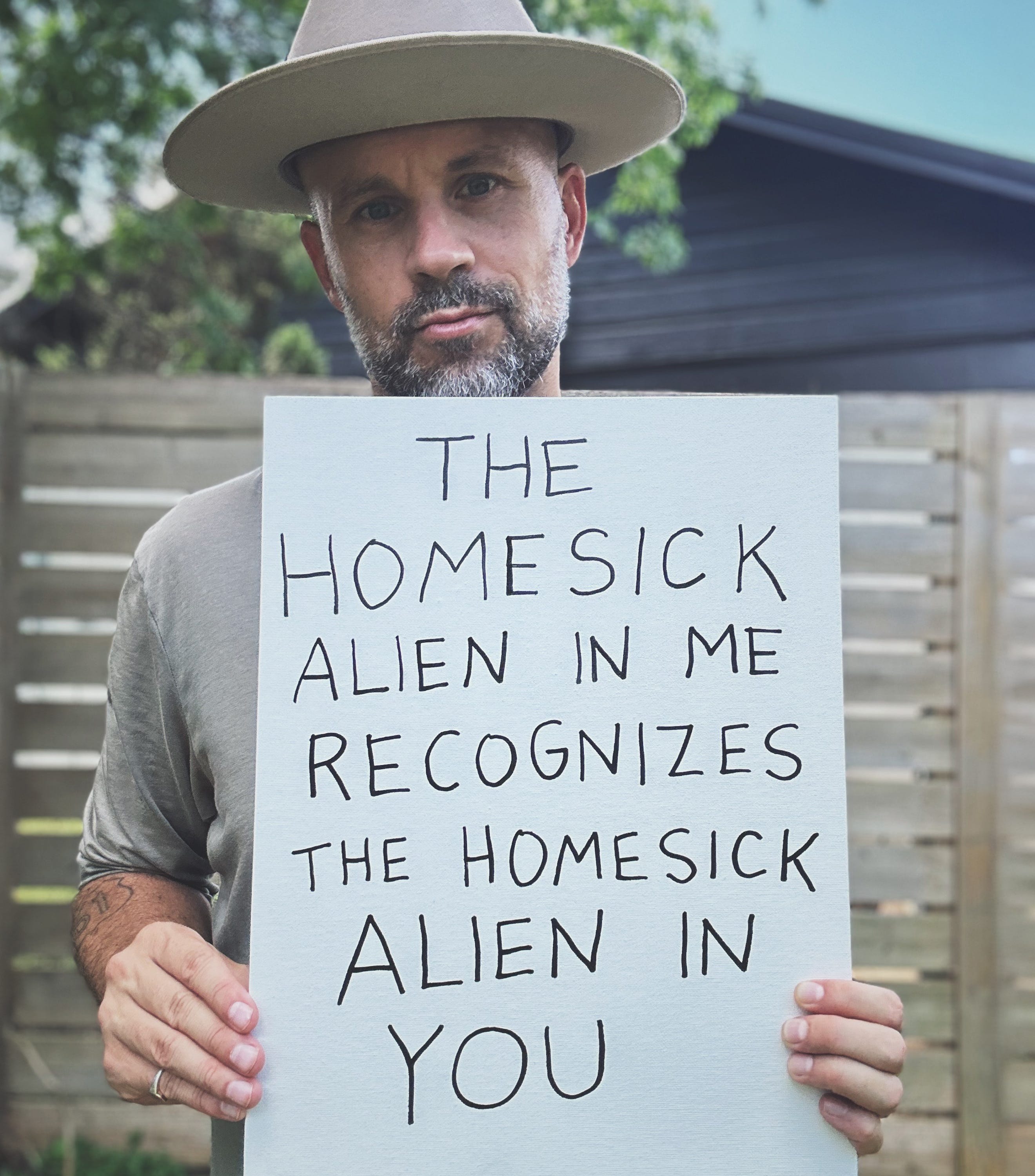
Instructions before visiting Earth – James McCrae
In the event that you wake up
and find your soul separated from source
and manifest into material form, don’t panic.
Your condition is only temporary.
You have been selected for the opportunity
of human incarnation.
This 3D simulation is designed
to break up the monotony of eternity
by giving you a fully immersive experience
as a distinct ego identity.
Your body will serve
as your physical avatar
as you navigate a dense and dramatic reality.
There will be many distractions
causing you to forget your true nature and origin.
You will experience a range of emotions
from joy to loneliness to despair.
But remember – no matter
what trials and traumas you encounter,
your soul remains perfectly safe.
At times you may feel lost or afraid.
This is totally normal.
If you ever need guidance,
simply slow down your busy mind
and bring your awareness
to the quiet place
inside yourself.
On this planet, nothing is permanent.
People and things will come and go.
You will fall in love and form sentimental attachments
only to lose everything you hold dear.
So cling to nothing too tightly, even yourself,
and when it’s time to let go, let go with grace,
for nothing is owned, only borrowed.
As you walk among
the people on the planet,
try to be a good guest.
Tread lightly. Remember
that you are only visiting.
Don’t make a mess.
Listen more than you speak.
Give more than you take.
Don’t keep your soft heart
locked inside a glass cage,
protected from wear and tear.
You’ll never make it out alive
and time passes quickly.
So come back with some battle scars
and good stories to tell.
Poetry
- A Dog Has Died – Pablo Neruda
- A Moment of Silence – Emmanuel Ortiz
- A Quiet Life – Baron Wormser
- A Wreath to the Fish – Nancy Willard
- Alone – Jack Gilbert
- Another Planet – Dunya Mikhail
- Be Kind, Rewind – Neil Silberblatt
- Black Momma Math – Kimberly Jae
- Boplicity or Jimmy Throws a Houseparty for Huey Newton – Daniel B. Summerhill
- Capitol Air – Allen Ginsburg
- Combat Primer – Charles Bukowski
- Crow Blacker Than Ever – Ted Hughes
- Dismiss Whatever Insults Your Own Soul – Walt Whitman
- Don’t fall in love with a woman who reads – Martha Rivera-Garrido
- Failing and Flying – Jack Gilbert
- Feel Mo – Michael Korson
- Footprints In Your Heart – Eleanor Roosvelt
- For Calling the Spirit Back from Wandering the Earth in Its Human Feet – Joy Harjo
- Forgetfulness – Billy Collins
- Growing Old – Emma Rosenberg
- Half-light – Dāshaun Washington
- Homesick: A Plea for Our Planet – Andrea Gibson
- How She Heard It – Todd Davis
- How to Slay a Dragon – Rebecca Dupas
- I Talked to a Lady – Tanya Howden
- If You Knew – Ellen Bass
- Instructions before visiting Earth – James McCrae
- KINDNESS – Naomi Shihab Nye
- Love is Not All – Edna St. Vincent Millay
- Men – Maya Angelou
- Millennium Blessing – Stephen Levine
- my brain and heart divorced ~ john roedel
- Ode to Those Who Block Tunnels and Bridges – Sam Sax
- Old Man Eating Alone – Billy Collins
- Relax – Ellen Bass
- Shoveling Snow With Buddha – Billy Collins
- Sleeping in the Forest – Mary Oliver
- Small Stack of Books – Blake Nelson
- Soliloquy of the Solipsist – Sylvia Plath
- Squirrel – Lynn Ungar
- Tangled Up In Blue – Bob Dylan
- The Caveman’s Lament – Brian Bilston
- The Four Noble Truths – Jake Onami Agnew
- The History of One Tough Motherfucker – Charles Bukowski
- The Layers – Stanley Kunitz
- The Long Boat – Stanley Kunitz
- The Moon is Full Tonight – Billy Collins
- The Shyness – Sharon Olds
- The War Works Hard – Dunya Mikhail
- The World is Both Burning and Blooming – Karen Salmansohn
- To Diego with Love – Frida Kalko
- Tryst with Death – Gina Puorro
- Two poems – Wendell Berry
- Two poems – Yehuda Amichai
- Two-bloods – Rolando Kattan
- Wage Peace – Mary Oliver
- War Primer – Bertholt Brecht
- We are the Trees – J Raymond
- We will meet, don’t be in such a rush – Hala alShrouf
- What I Learned From Listening to a Stutterer – Ellen Zorin
- Who Says Words With My Mouth? – Jalal ad-Din Rumi