Racial Awareness
now browsing by category
This category is for dealing with the topic of racial awareness.
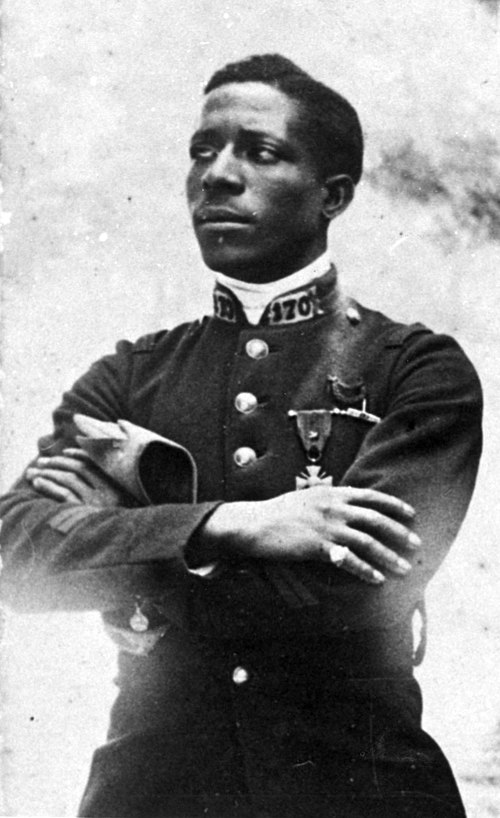
Eugene Bullard – a hidden figure
When the President of France visited the United States in April 1960, he asked the FBI to help him find a man.
The man he was looking for was an American citizen. He was sixty-four years old. He had been awarded fifteen French military decorations and — six months earlier, in a ceremony in Paris — had been made a Knight of the Légion d’honneur, the highest civilian honor France can give. The medal had been pinned to his chest by the President himself, who had publicly called him un véritable héros français. A true French hero.
The FBI located the man within a few days.
He was operating an elevator at Rockefeller Center in New York City.
The elevator operator’s name was Eugene Bullard. He had been born in Columbus, Georgia, in 1895, the son of a man whose own father had been a slave.
He had run away from Columbus at the age of eleven, after watching a white mob nearly lynch his father.
He spent the next several years drifting through the American South. At sixteen, he stowed away on a German freighter at Norfolk, Virginia. He landed in Aberdeen, Scotland. From there he made his way to London, where he learned to box. By 1913, at eighteen, he was prizefighting in Paris.
When Germany invaded France in August 1914, Bullard was nineteen years old. He had no legal obligation to fight. He had no French citizenship.
He went to the recruiting office on October 19, 1914, and signed up for the French Foreign Legion.
He spent the next eighteen months as an infantryman in some of the worst fighting of the war — at the Somme, at Champagne, at Verdun. He was wounded three times. The third wound, on March 5, 1916, tore open his thigh and left him with permanent damage to his leg.
He was twenty years old. The doctors told him he would not return to the infantry.
He decided he wanted to fly.
In a Paris café in the spring of 1916, while he was recovering, Bullard mentioned to three white American friends that he was thinking of joining the French air service. A Mississippian named Jeff Dickson laughed.
Gene, Dickson said, you know damn well there aren’t any Negroes in aviation.
Bullard answered: Sure do. That’s why I want to get into it. There has to be a first to everything, and I’m going to be the first.
Dickson bet him two thousand dollars he would not make it.
Bullard took the bet. He earned his pilot’s license on May 5, 1917. He won the bet.
He reported to the front in August 1917 and flew approximately twenty combat missions over the next three months in a SPAD VII. The fuselage was painted with a bleeding heart pierced by a knife and the French phrase Tout le Sang qui Coule est Rouge — All Blood that Flows is Red.
He carried, on every combat flight, a small capuchin monkey named Jimmy in the front of his flight jacket.
The French press began calling him L’Hirondelle Noire — the Black Swallow.
When the United States entered the war in 1917, Bullard immediately applied to transfer to the U.S. Army Air Service.
His application was rejected.
The U.S. Army Air Service had a policy, in 1917, of not accepting Black pilots. The other American pilots flying for France in his unit, all of them white, were transferred to the U.S. Air Service.
He was the only one who was not.
For the next twenty years, he was one of the most familiar faces in the Montmartre nightlife of Paris between the wars. He owned a nightclub called L’Escadrille. He spoke fluent French, English, and German. Hemingway drank there. Fitzgerald drank there. Langston Hughes drank there. Josephine Baker performed there. Louis Armstrong was a personal friend.
When Germany invaded Poland in 1939, Bullard was forty-four. His fluent German and his ownership of a nightclub frequented by German officers made him useful to the French Resistance. He became an intelligence agent — eavesdropping in his own bar on conversations between German officers who did not know he understood every word.
When France fell in June 1940, friends in the Resistance smuggled him across the Spanish border before the Gestapo could arrest him.
He came back to the United States for the first time in twenty-eight years.
He arrived in New York with thirty dollars in his pocket and a permanent limp.
He did not return to a hero’s welcome. He returned to a country that had no idea who he was.
He worked at a perfume counter. He worked as a security guard. He worked at the Staten Island shipyards. By the late 1940s, he had taken the job that he would hold for most of the rest of his life.
He operated the elevator at Rockefeller Center.
He was wearing the elevator uniform on the day a producer from NBC came down from the studios upstairs to ask if he was the man Charles de Gaulle had been looking for.
A few weeks later, NBC sent a film crew to interview him in the lobby. The studios where NBC produced The Today Show were on the floors above. He had operated the elevator that took the network executives up to those studios every morning for nearly ten years. He had not been recognized as he did it.
He went back to operating the elevator the following Monday.
He died of stomach cancer on October 12, 1961, three days after his sixty-sixth birthday.
He was buried in the French War Veterans’ section of Flushing Cemetery, in Queens, in the uniform of the French Foreign Legion. The casket was draped with the French flag.
In 1994 — thirty-three years after his death — the United States Air Force formally commissioned Eugene Jacques Bullard as a Second Lieutenant, posthumously.
It was the first commission the U.S. military had ever offered him.
He had been the first Black combat pilot in American history.
The French had been calling him a hero since 1917.
The Americans got around to it in 1994.
Harriet Wilson
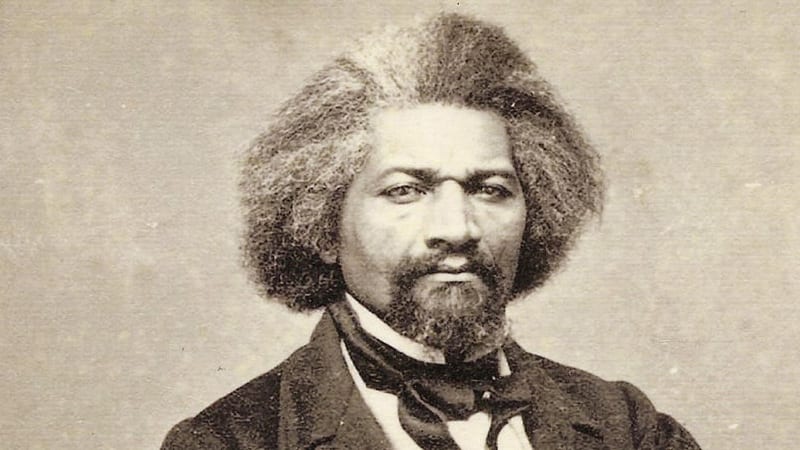
In 1825, Harriet E. Wilson was born in Milford, New Hampshire, to a white mother and a Black father. After her mother’s death, she was given away as an indentured servant, spending her childhood in labor and hardship instead of school or play.
As an adult, abandoned by her husband and left to care for her sick child, Harriet worked as a seamstress, cleaner, and domestic servant. Poverty followed her, but she refused to be silenced.
In 1859, she accomplished something extraordinary: she published Our Nig; or, Sketches from the Life of a Free Black. It was the first novel ever published by an African American woman in the United States. With unflinching honesty, Harriet exposed that racism and exploitation existed not only in the South but also in the so-called “free” North.
The book sold poorly, and Harriet’s hope that it might provide for her son was never fulfilled. After his death, she moved to Boston, where she became a spiritualist and reformer, offering help to others even as her own name faded into obscurity.
When Harriet Wilson died in 1900, she was buried without recognition. But in 1982, scholar Henry Louis Gates Jr. rediscovered her book, restoring her place as a pioneer of American literature.
Her voice, once forgotten, now rings out again. Harriet Wilson’s story is one of resilience, courage, and proof that even if the world forgets, words can rise again to be remembered.”
Sharna’s Great Great Grandmother
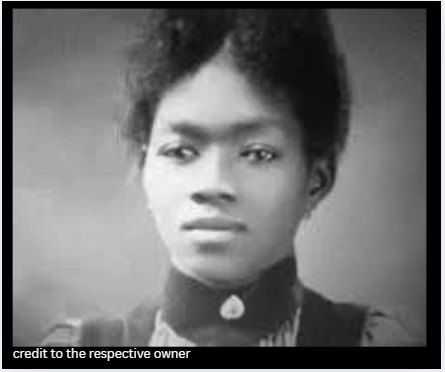
Christina LeVant was born enslaved in 1842 on a plantation in Marion S.C. Her father Frank LeVant and his wife were bought over on a slave ship from the east coast of Africa. Christina, known as Tina, worked as a lady’s maid to her slave owner Mrs. W.J. Baker. When Tina’s mother was on her deathbed, she begged her owner Mrs. Baker, not to sell her children. Mrs. Baker granted her request and later in her will, left Tina and her older sister to her brother.
Mrs. Baker died the summer before the Civil War broke out and Tina, then 17 was put in the fields by her new owner, to work as a water girl. She would fill a heavy wooden pail with water, carry it on her head and walk a mile around the plantation many times a day to carry water to the slaves working in the fields. In addition to carrying water, Tina also watched for the overseer and warned the slaves so that he wouldn’t catch them praying. She continued this work until the age of 20 when the war was over.
When the Emancipation Proclamation was in effect, many of the freed slaves stayed on the plantation under contract with the owners who agreed to give them part of the crops raised. Tina stayed for some time. During her stay, a Negro Clergyman named “Smith” went to Marion to organize a church. He distributed Bibles. Tina kept hers close to her heart and read it faithfully. She was one of the lucky slave children who was taught to read and write by her owners. One of the plantation owners gave them an acre of land to build a church. The site of the church was called African Methodist Hill.
As time went on a lay preacher, named John Platt was in charge of the African Methodist Zion church in Marion, S.C. Tina later married the son of John Platt Sr in 1868, and together they were able to save enough to buy a small plot of land for a house and garden. They raised vegetables, chickens and a few pigs. Tina spun cotton cloth to clothe her children. She also made her own bread and soap. In 1905 John Jr and Tina moved to Waterbury CT where they helped organize the Pearl St. Church. Tina and John had 11 children (Elliot, George, John, Arthur, Mary, Fannie, Daisy, Florence, Ruth, and 2 died at birth). Tina and John worked hard to give their children an education.
Three of the girls attended Livingston College and one of them became a Domestic Science teacher. Arthur graduated from Boston university Law School and practiced in Spartanburg S.C. George became one of the best trap drummers in the theater and worked with bands in Hollywood. John also graduated from Livingston College and was an ordained minister in 1915. He became a supply Minister for the New England District of the AME Zion Church.
Tina later moved to Medfield MA where she lived with her daughters Fannie and Ruth. Together they had a large garden 150 chickens and 4 pigs. In addition to her 11 children, Tina had 26 grandchildren and over 22 great grandchildren. John died in 1930 at the age of 83 but Tina lived until 1943 dying at the age of 101.