Archives
now browsing by author
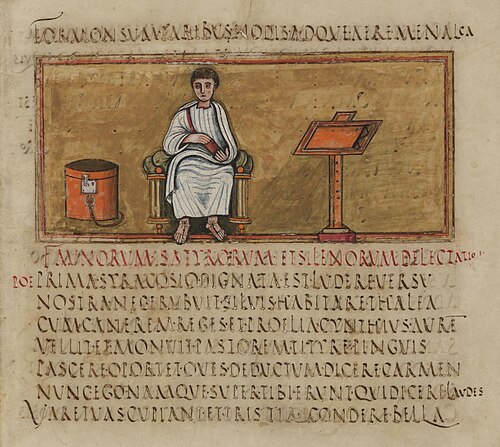
Georgics: Book I excerpt – Virgil
Rain never takes men unawares:
either the cranes, airborne, fly before it, as it reaches
the valley’s depths, or a heifer looks up at the sky
and sniffs the air with nostrils spread,
or the swallows twitter circling the pools,
and the frogs in the mud croak their ancient lament.
And often the ant, beating out a narrow track,
brings eggs from an innermost nest, and a huge rainbow
drinks, and a great troop of rooks leaving the fields
beat their wings together densely, in ranks.
Then the cruel raven’s deep cry calls up the rain,
and, alone with himself, he walks the dry sands.
Even girls, spinning, at their nocturnal task, have not failed
to note the coming storm, seeing the oil sputter
in the fiery lamp, and a clot of soot gather on the wick.
No less, after rain, do we predict sunlight and clear skies,
and recognize fair weather by certain signs:
since the stars’ sharp edges are not obscured
and the Moon rises, not dimmed by her brother’s rays,
and thin fleecy clouds no longer drift across the sky:
But the mists seek out the valleys more, and settle
on the plains, and the owl, watching the sunset
from some high hill, gives out its twilight calls in vain.
Now the rooks repeat their clear calls, three or four times,
with narrowed throats, and often caw to themselves
in their high nests among the leaves, delighting
in some unusual pleasantry: they’re glad, the rain over,
to see their sweet nests and their little chicks again:
not that I think they have divine wisdom
or greater knowledge of the workings of Fate:
but when the weather changes, and the rain from fickle skies,
and Jupiter, among the wet South winds, makes what was now
rarefied, dense, and makes dense what was rarefied,
ideas in their minds alter, and their hearts feel differently,
differently to when the wind was chasing the clouds.
So that chorus of birds in the fields, the delight
of the cattle, the triumphant cries of the rooks.
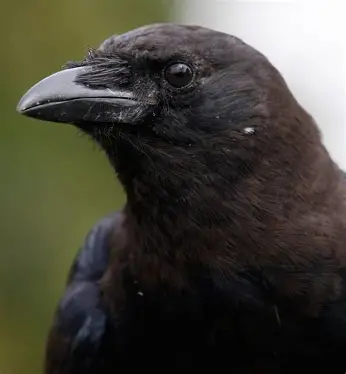
Crow – Doug Anderson
Crows
Hunch in the trees
to gossip
about God and his inexorable
experimenting,
about deer guts and fish so stupid
you could sell them air
and how out in the deserts
there’s a dog called coyote
with their mind
but no wings.
Crow with Iroquois hair.
Crow with a wisecrack for everybody,
Crow with his beak
thrust through a bun,
the paper still clinging.
Then one says something
and they all leave,
complaining
the trees are not what they used to be.
Crow with oilslick eyes.
Crow with a knife
sheathed in a shark’s fin.
Crow
in a midnight blue suit
standing in front of a judge:
Your Honor, I didn’t
kill him, just ate him
and I wasn’t impressed.
It Happens All the Time – Hafez
It happens all the time in heaven,
And some day
It will begin to happen
Again on earth –
That men and women who are married,
And men and men who are
Lovers,
And women and women
Who give each other
Light,
Often will get down on their knees
And while so tenderly
Holding their lover’s hand,
With tear-filled eyes,
Will sincerely speak, saying,
“My dear,
How can I be more loving to you;
How can I be more kind?”

I Wish I Knew How It Would Feel to Be Free -Billy Taylor and Dick Dallas
Well, I wish I could be like a bird in the sky
How sweet it would be if I found I could fly
Oh, I’d soar to the sun and look down at the sea
And then I’d sing ’cause I’d know, yeah
Then I’d sing ’cause I’d know, yeah
Then I’d sing ’cause I’d know
I’d know how it feels
I’d know how it feels to be free, yeah
Oh, I’d know how it feels to be free.

Against the Odds – David Lerner
it’s impossible
that we keep breathing
with all the years
pressing on our chest
it’s impossible
that we keep walking
given the condition
of the heart’s terrain
it’s impossible
that laughter continues to spill
from the cracks in our sorrow
that anger continues to be
a kind of faith
that the small graces
coffee, clean socks, the stillness of night
still sustain us
sometimes
it’s impossible
how we break on our dreams
and then dream them again
how amidst the thousand small terrors
of daily life
it is possible to be kind
how as the ax falls
and nooses swing
we go on checking the TV Guide for decent movies
accepting some phone calls, dodging others
doing battle with the rent and the weather and
the holes in our shoes and
the distance between us
there is something inside me that says
yes
there is no way out
you have to play this terrible guitar
until the strings break
or your fingers
but the music I know
in the moments between
the panic I hold more intimately
than any lover
it’s impossible
how much sorrow
a smile can hold
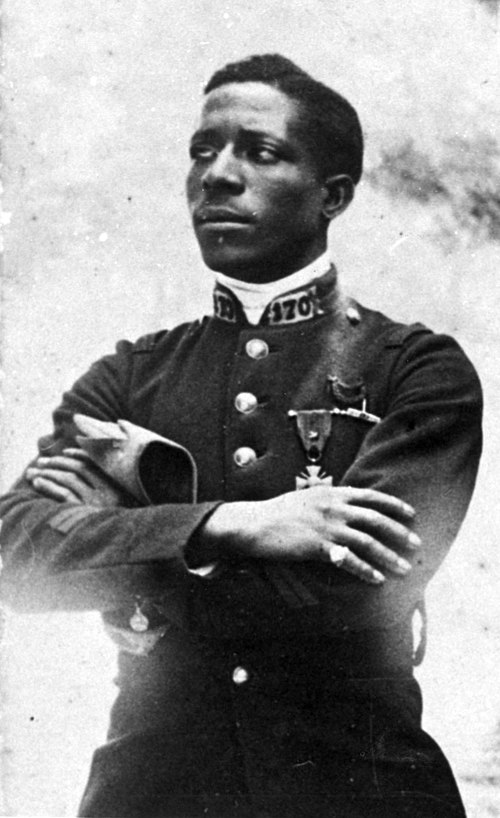
Eugene Bullard – a hidden figure
When the President of France visited the United States in April 1960, he asked the FBI to help him find a man.
The man he was looking for was an American citizen. He was sixty-four years old. He had been awarded fifteen French military decorations and — six months earlier, in a ceremony in Paris — had been made a Knight of the Légion d’honneur, the highest civilian honor France can give. The medal had been pinned to his chest by the President himself, who had publicly called him un véritable héros français. A true French hero.
The FBI located the man within a few days.
He was operating an elevator at Rockefeller Center in New York City.
The elevator operator’s name was Eugene Bullard. He had been born in Columbus, Georgia, in 1895, the son of a man whose own father had been a slave.
He had run away from Columbus at the age of eleven, after watching a white mob nearly lynch his father.
He spent the next several years drifting through the American South. At sixteen, he stowed away on a German freighter at Norfolk, Virginia. He landed in Aberdeen, Scotland. From there he made his way to London, where he learned to box. By 1913, at eighteen, he was prizefighting in Paris.
When Germany invaded France in August 1914, Bullard was nineteen years old. He had no legal obligation to fight. He had no French citizenship.
He went to the recruiting office on October 19, 1914, and signed up for the French Foreign Legion.
He spent the next eighteen months as an infantryman in some of the worst fighting of the war — at the Somme, at Champagne, at Verdun. He was wounded three times. The third wound, on March 5, 1916, tore open his thigh and left him with permanent damage to his leg.
He was twenty years old. The doctors told him he would not return to the infantry.
He decided he wanted to fly.
In a Paris café in the spring of 1916, while he was recovering, Bullard mentioned to three white American friends that he was thinking of joining the French air service. A Mississippian named Jeff Dickson laughed.
Gene, Dickson said, you know damn well there aren’t any Negroes in aviation.
Bullard answered: Sure do. That’s why I want to get into it. There has to be a first to everything, and I’m going to be the first.
Dickson bet him two thousand dollars he would not make it.
Bullard took the bet. He earned his pilot’s license on May 5, 1917. He won the bet.
He reported to the front in August 1917 and flew approximately twenty combat missions over the next three months in a SPAD VII. The fuselage was painted with a bleeding heart pierced by a knife and the French phrase Tout le Sang qui Coule est Rouge — All Blood that Flows is Red.
He carried, on every combat flight, a small capuchin monkey named Jimmy in the front of his flight jacket.
The French press began calling him L’Hirondelle Noire — the Black Swallow.
When the United States entered the war in 1917, Bullard immediately applied to transfer to the U.S. Army Air Service.
His application was rejected.
The U.S. Army Air Service had a policy, in 1917, of not accepting Black pilots. The other American pilots flying for France in his unit, all of them white, were transferred to the U.S. Air Service.
He was the only one who was not.
For the next twenty years, he was one of the most familiar faces in the Montmartre nightlife of Paris between the wars. He owned a nightclub called L’Escadrille. He spoke fluent French, English, and German. Hemingway drank there. Fitzgerald drank there. Langston Hughes drank there. Josephine Baker performed there. Louis Armstrong was a personal friend.
When Germany invaded Poland in 1939, Bullard was forty-four. His fluent German and his ownership of a nightclub frequented by German officers made him useful to the French Resistance. He became an intelligence agent — eavesdropping in his own bar on conversations between German officers who did not know he understood every word.
When France fell in June 1940, friends in the Resistance smuggled him across the Spanish border before the Gestapo could arrest him.
He came back to the United States for the first time in twenty-eight years.
He arrived in New York with thirty dollars in his pocket and a permanent limp.
He did not return to a hero’s welcome. He returned to a country that had no idea who he was.
He worked at a perfume counter. He worked as a security guard. He worked at the Staten Island shipyards. By the late 1940s, he had taken the job that he would hold for most of the rest of his life.
He operated the elevator at Rockefeller Center.
He was wearing the elevator uniform on the day a producer from NBC came down from the studios upstairs to ask if he was the man Charles de Gaulle had been looking for.
A few weeks later, NBC sent a film crew to interview him in the lobby. The studios where NBC produced The Today Show were on the floors above. He had operated the elevator that took the network executives up to those studios every morning for nearly ten years. He had not been recognized as he did it.
He went back to operating the elevator the following Monday.
He died of stomach cancer on October 12, 1961, three days after his sixty-sixth birthday.
He was buried in the French War Veterans’ section of Flushing Cemetery, in Queens, in the uniform of the French Foreign Legion. The casket was draped with the French flag.
In 1994 — thirty-three years after his death — the United States Air Force formally commissioned Eugene Jacques Bullard as a Second Lieutenant, posthumously.
It was the first commission the U.S. military had ever offered him.
He had been the first Black combat pilot in American history.
The French had been calling him a hero since 1917.
The Americans got around to it in 1994.
RACIAL AWARENESS
Do You Know What Today Is? – Danez Smith
unfortunately, or blessed, it could have been
hours, or years, but it was hours
we disappeared into, touch i shouldn’t
savor, not this day, not while missing you,
not this deep in love, but a year ago,
or was it days, we said i do
which under it laid dozens more commitments,
one being our commitment to pleasure,
to touch, to the touch of others, so i do
but also i will continue to do it, that it,
with people that are not you—love,
believe it, or not, lives in that promise
too, i love the sounds others pull from you,
i love your ecstasy even if i’m not around
to engineer it, and here i am, on the other
side of the promise, on the other side
of the world, underneath this person
who i have promised nothing
but my attention and effort until it’s done,
and it was, done under the moon
until the rain started and, then, done
under the rain, i am ashamed to say it,
but i must say it: i would have asked them
to stay, to do it again, to touch me forever
had i not, and thank God i did,
placed my forever in you, but amor,
amor, you should have seen it, us:
beneath the rain, a storm,
under the promise,
my loaned breath.
God – Brian Doyle
By purest chance I was out in our street
when the kindergarten
Bus mumbled past going slow and I
looked up just as all seven
Kids on my side of the bus looked at
me and I grinned and they
Lit up and all this crap about God being
dead and where is God
And who owns God and who hears
God better than whom is the
Most egregiously stupid crap
imaginable because if you want to
See God and have God see you and
have this mutual perception
Be completely untrammeled by blather
and greed and comment,
Go stand in the street as the
kindergarten bus murmurs past. I’m
Not kidding and this is not a metaphor.
I am completely serious.
Everyone babbles about God but I saw
God this morning just as
The bus slowed down for the stop on
Maple Street. God was six
Girls and one boy with a bright green
and purple stegosaurus hat.
Of course God would wear a brilliantly
colored tall dinosaur hat!
If you were the Imagination that
dreamed up everything that ever
Was in this blistering perfect terrible
world, wouldn’t you wear a
Hat celebrating some of the wildest
most amazing developments?

Psalm for the Slightly Tilted – Ilya Kaminsky
This is not
a good year.
But it has
witnesses.
When you see them protest the powerful,
since who else does,
they stand
like flagpoles outside the courthouse
after a northeaster.
They came with
the wrong shoes
for revolution.
Still,
they showed up.
Comfort, Lord,
their bodies—
each a question mark
doing time
as a coat rack,
hung with borrowed jackets.
They are your legion
of bent spoons.
They are the only ones
who showed up—
with their orthopedic flair.
I saw my people lean—
not toward hope but toward each other.
They chant off-rhythm
and mean it.
These are my kind of people:
no tears—just
steam from a kettle
that never quite boils.
In times like these, don’t forget us:
the lopsided
leaning on one another.