
Templates
now browsing by category
This is for adding content and maintaining the standardized layout.
Voyage to the Beginning
For my first 9D Breathwork workshop in 2025 I had set the intention to discover what my “soul” or inherited “essence” was and I had been very surprised, as described elsewhere, to discover that when I was in the womb I was both male and female and that I only became male after my birth by virtue of my genitalia. I felt that experience had been very important in terms of my soul discovery, or my soul retrieval, or my soul access work; that there was nothing more foundational than for me to understand that I was both male and female.
So when I went back for my second breath session a few months later I had the same intention, which was to learn more about my soul, and, for some reason, when I began deepening, I found myself in the company of my my father’s mother’s mother, my great grandmother, Toby Warshavski, the woman I wrote that little poetry book about how she saved my life when I was four years old. And as I thought about my beloved great grandmother, I remembered that she too had been a little child, and that she had had a father and a mother, although it was the father’s line that I was particularly interested in. And I imagined/visualized her father, probably in the 1830s, and I greeted him and actually opened my arms and hugged him. And then I remembered that he had been a little boy and had had a father and that took me back into the 1780s or the American revolutionary times, and I hugged that man and then that father’s father went back to the 17th and then the 16th century and the 15th century, and as I was following these men and hugging these men from whom I was descended I got back to the time of the butcher Columbus’s voyage to the so-called New World, and the fact that I had had Jewish ancestors in Moorish Spain at that time, and that Jews were on Columbus’s ships, and that my ancestors of that time had learned about the New World, at the same time that they were being expelled from Moorish Spain, and that some of my ancestors were people who had walked to Spain in the middle ages and had then walked away from Spain, often back to the holy land or Northern Africa or eastern European countries. These very people, including some of my ancestors, had been welcome in many Muslim countries, and the image of my ancestors walking to and fro became very powerful for me, and I traveled back beyond the Middle Ages, and continued back to the time of Christ. Only I was now not going generation by generation but jumping back centuries at a time, back to Christ, and then back to Moses, and beyond. And the fact was that I had ancestors who had walked into Egypt and generations later ancestors who walked with Moses from Egypt to the holy land. And there I was, back in the time of King David and young David and Goliath … and my ancestors were there and I hugged them and I was there.
I then went back to the cave people where I’ve often started my autobiography and have often said that I can absolutely and concretely feel that I was descended from people 50,000 years ago making handprints in blood on the walls of the cave. And I went beyond that, back to the earliest stages of humankind, and I felt that I had walked back millions of years, walking, walking, back to the Australopithecines, back to Lucy and her kin, and I knew for certain that one of her contemporaries was my ancestor, both a male and a female ancestor. And I pictured the primates as I continued as my own direct ancestor walking backwards through time. Walking. Walking. And I kept going further and further back… back to when the first animals walked on the land, and then back to being the creatures in the sea who were my ancestors. And then back to the first forms of life on Earth. And then even back to the big bang, to the explosion that had fostered the current iteration of space and time and matter, and I was back at my lifelong obsession with the question of how something could come from nothing … or how it always was – which solved nothing about origins – there being just soooo much mass – and I truly don’t understand. And I know I don’t know. And can’t know. And I can’t stand that I don’t know the answer to how something can come from nothing and that saying it always was and always will be solves nothing. Whereupon I started mumbling “I know that I don’t know,” and “I know that I can’t know.”
And then started my journey of returning to the present, first as atoms, then molecules, then stars and suns, planets, the Earth and the sun, and the elements that became the combination of molecules that produced the first life that led to the creatures of the sea that came out onto the land and that were able to walk into primates and Lucy and I was working my way back, and back, and back. And I came back to my great grandmother, Toby. And I came back to my grandfather on my father’s side, Samuel, a man I knew, and I came back to my father, and I knew with great clarity something about my father’s deep deep tension between the soft soul of the man he was and the demand that as a man he be strong and macho and fearless and how I had directly inherited the part of me that needed to be a man, and to be strong, and to know what being a father was and then to the very point in my life when I realized I no longer needed to be that person, that I had become a spiritual person, that I was on a spiritual journey and even believed in the existence of some sort of higher power which I’ve actually come to “know,” and I felt in that sense that I also knew as much of my “soul” as I would ever be able or capable of knowing, and it was satisfactory, that although I knew I couldn’t “know,” and I would never know how something came from nothing, that I had traced the journey of my soul from its origins into my current body and current consciousness where it lives appreciatively today.
MISCELLANEOUS

I Bow to Time
I bow to time
Quite literally
In the kitchen
Before the clock with the pendulum
I pause to consider my options
And conflicting desires
Wants, needs
To walk in sunshine
To read, to exercise
To correspond, to work
To eat, to dream
To study, to sing
I bow before time
As a Japanese warrior
Bowing in respect before the battle
Bowing in respect after the battle
Win or lose
Honoring the adversary
Who makes your battle possible
Honoring the ally
Who makes your battle possible
Meaningful
Challenging
Joyful
Sad
Inside the bow is gratitude and respect
For what I am given and what I am not
Here
In this nanosecond of cosmic time that is my life
Our life
Awareness
Choices
Gratitude
Love
Swept up in time
One moment it is stormy
The next bright sunshine
If you don’t like the weather
Wait around a few minutes
I bow to the clock
To time
To limits
To reality so called
To my spirit
To my flesh
To the great mind
The bow
Is delicious
© 1980s
Soul Voyage – 2025
For my first 9D Breathwork workshop in 2025 I had set the intention to discover what my “soul” or inherited “essence” was and I had been very surprised, as described elsewhere, to discover that when I was in the womb I was both male and female and that I only became male after my birth by virtue of my genitalia. I felt that experience had been very important in terms of my soul discovery, or my soul retrieval, or my soul access work; that there was nothing more foundational than for me to understand that I was both male and female.
So when I went back for my second breath session a few months later I had the same intention, which was to learn more about my soul, and, for some reason, when I began deepening, I found myself in the company of my my father’s mother’s mother, my great grandmother, Toby Warshavski, the woman I wrote that little poetry book about how she saved my life when I was four years old. And as I thought about my beloved great grandmother, I remembered that she too had been a little child, and that she had had a father and a mother, although it was the father’s line that I was particularly interested in. And I imagined/visualized her father, probably in the 1830s, and I greeted him and actually opened my arms and hugged him. And then I remembered that he had been a little boy and had had a father and that took me back into the 1780s or the American revolutionary times, and I hugged that man and then that father’s father went back to the 17th and then the 16th century and the 15th century, and as I was following these men and hugging these men I got back to the time of the butcher Columbus’s voyage to the so-called New World, and the fact that I had had Jewish ancestors in Moorish Spain at that time, and that Jews were on Columbus’s ships, and that my ancestors of that time had learned about the New World, and were also expelled from Moorish Spain, and that some of my ancestors were people who had walked to Spain in the middle ages and had then walked away from Spain, often back to the holy land or Northern Africa or eastern European countries. These people, including some of my ancestors had been welcome in many Muslim countries, and the image of my ancestors walking to and fro became very powerful for me, and I went back beyond the Middle Ages, and then I went back to the time of Christ. And I was now not going generation by generation but jumping back centuries at a time, back to Christ, and then back to Moses. And the fact is that I had ancestors who walked with Moses from Egypt to the holy land. And then I was back in the time of King David and young David and Goliath … and my ancestors were there and I hugged them and I was there.
I then went back to the cave people where I’ve often started my autobiography and have often said that I can absolutely and concretely feel that I was descended from people 50,000 years ago making handprints in blood on the walls of the cave. And then I went beyond that, back to the earliest stages of humankind, and I felt that I had walked back millions of years, walking, walking, back to the Australopithecines, to Lucy, and I knew for certain that one of her contemporaries was my ancestor, both a male and a female. And I pictured the primates walking backwards through time. Walking. Walking. And I kept going further and further back… back to when the first animals walked on the land, and then back to being the creatures in the sea who were my ancestors. And then back to the first forms of life on Earth. And then even back to the big bang, to the explosion that had fostered the current iteration of space and time and matter, and I was back at my lifelong obsession with the question of how something could come from nothing … or how it always was – which solved nothing about origins – and there’s just soooo much mass – and I just don’t understand. And I know I don’t know. And can’t know. And I can’t stand that I don’t know the answer to how something can come from nothing and that saying it always was and always will be solves nothing. Whereupon I started mumbling “I know that I don’t know,” and “I know that I can’t know.” And then I started my journey of returning to the present, first as atoms, then molecules, then stars and suns, planets, the Earth and the sun, and the gases that led to the combination of molecules that produced the first life that led to the creatures of the sea that came out onto the land and that were able to walk into primates and Lucy and I was working my way back, and back, and back. And I came back to my great grandmother. I came back to my grandfather on my patriarchal side, a man who I knew, and I came back to my father, and I knew something about my father’s deep deep tension between the soft soul of the man he was and the demand that as a man he be strong and macho and fearless and blah blah blah and how I had directly inherited the part of me that needed to be a man, and needed to be strong, and needed to know what being a father was and then, at this very point in my life, when I realized I no longer needed to be that person, that I had become a spiritual person, that I was on a spiritual journey and even believed in the existence of some sort of higher power which I’ve actually come to “know,” and I felt in that sense that I also knew as much of my “soul” as I would ever be able or capable of knowing, that it was satisfactory, and that although I knew I couldn’t – that I didn’t – “know,” and I would never know how something came from nothing, that I had traced the journey of my soul into my current body and current consciousness where it lives today.
MEMOIRS
Bridges
Here is an aspect of New York
The majestic city
On 153 St
Where heaven and earth come together
In six lane highways that never sleep
And graveyards
Where once people sleep forever
Where the most marvelous bridges
Span the most magnificent river
And a tiny lighthouse
Sits dwarfed beneath miraculous towers
Staring forever at the flowing Hudson
The boats at night
Illuminated beneath the beloved bridge
A miracle of correspondence
Uniter of states, of families
And regal palisades
Ancient gravestones sunk into soil
Reflect the moon on all Manhattan
The fish beneath the water
The fallen
Paintings brought home
From junkyards in France
Carvings and cravings
The expression of Africans
Books and bottles
Darkness and light
Consumed and consuming
Eternal, finite, beloved island
Home of the Weckquaesgeeks
Dancers and fish spearers
Nomadic hunters
Camped on the river
Making kettles of bark
In their canoes
Sacred Algonquin island
Decimated entirely in a holocaust
Wrought by greedy, armed, sick
Mercenaries and missionaries
Their sachem taken captive
Negotiates a treaty of peace
And the island is bought
From those who do not own it.
Generations and centuries flow by
And people live here still
Want to live here
In the millions
The soil good
The rivers rich
The hunting blessed
There are magnificent bridges
To what is known
And shall never be known
Where heaven and earth come together
In six lane highways
Along the river
POETRY

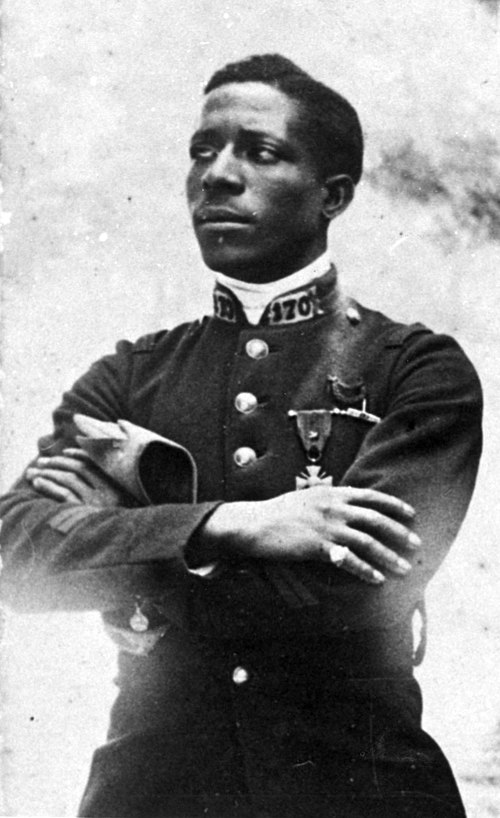
Eugene Bullard – a hidden figure
When the President of France visited the United States in April 1960, he asked the FBI to help him find a man.
The man he was looking for was an American citizen. He was sixty-four years old. He had been awarded fifteen French military decorations and — six months earlier, in a ceremony in Paris — had been made a Knight of the Légion d’honneur, the highest civilian honor France can give. The medal had been pinned to his chest by the President himself, who had publicly called him un véritable héros français. A true French hero.
The FBI located the man within a few days.
He was operating an elevator at Rockefeller Center in New York City.
The elevator operator’s name was Eugene Bullard. He had been born in Columbus, Georgia, in 1895, the son of a man whose own father had been a slave.
He had run away from Columbus at the age of eleven, after watching a white mob nearly lynch his father.
He spent the next several years drifting through the American South. At sixteen, he stowed away on a German freighter at Norfolk, Virginia. He landed in Aberdeen, Scotland. From there he made his way to London, where he learned to box. By 1913, at eighteen, he was prizefighting in Paris.
When Germany invaded France in August 1914, Bullard was nineteen years old. He had no legal obligation to fight. He had no French citizenship.
He went to the recruiting office on October 19, 1914, and signed up for the French Foreign Legion.
He spent the next eighteen months as an infantryman in some of the worst fighting of the war — at the Somme, at Champagne, at Verdun. He was wounded three times. The third wound, on March 5, 1916, tore open his thigh and left him with permanent damage to his leg.
He was twenty years old. The doctors told him he would not return to the infantry.
He decided he wanted to fly.
In a Paris café in the spring of 1916, while he was recovering, Bullard mentioned to three white American friends that he was thinking of joining the French air service. A Mississippian named Jeff Dickson laughed.
Gene, Dickson said, you know damn well there aren’t any Negroes in aviation.
Bullard answered: Sure do. That’s why I want to get into it. There has to be a first to everything, and I’m going to be the first.
Dickson bet him two thousand dollars he would not make it.
Bullard took the bet. He earned his pilot’s license on May 5, 1917. He won the bet.
He reported to the front in August 1917 and flew approximately twenty combat missions over the next three months in a SPAD VII. The fuselage was painted with a bleeding heart pierced by a knife and the French phrase Tout le Sang qui Coule est Rouge — All Blood that Flows is Red.
He carried, on every combat flight, a small capuchin monkey named Jimmy in the front of his flight jacket.
The French press began calling him L’Hirondelle Noire — the Black Swallow.
When the United States entered the war in 1917, Bullard immediately applied to transfer to the U.S. Army Air Service.
His application was rejected.
The U.S. Army Air Service had a policy, in 1917, of not accepting Black pilots. The other American pilots flying for France in his unit, all of them white, were transferred to the U.S. Air Service.
He was the only one who was not.
For the next twenty years, he was one of the most familiar faces in the Montmartre nightlife of Paris between the wars. He owned a nightclub called L’Escadrille. He spoke fluent French, English, and German. Hemingway drank there. Fitzgerald drank there. Langston Hughes drank there. Josephine Baker performed there. Louis Armstrong was a personal friend.
When Germany invaded Poland in 1939, Bullard was forty-four. His fluent German and his ownership of a nightclub frequented by German officers made him useful to the French Resistance. He became an intelligence agent — eavesdropping in his own bar on conversations between German officers who did not know he understood every word.
When France fell in June 1940, friends in the Resistance smuggled him across the Spanish border before the Gestapo could arrest him.
He came back to the United States for the first time in twenty-eight years.
He arrived in New York with thirty dollars in his pocket and a permanent limp.
He did not return to a hero’s welcome. He returned to a country that had no idea who he was.
He worked at a perfume counter. He worked as a security guard. He worked at the Staten Island shipyards. By the late 1940s, he had taken the job that he would hold for most of the rest of his life.
He operated the elevator at Rockefeller Center.
He was wearing the elevator uniform on the day a producer from NBC came down from the studios upstairs to ask if he was the man Charles de Gaulle had been looking for.
A few weeks later, NBC sent a film crew to interview him in the lobby. The studios where NBC produced The Today Show were on the floors above. He had operated the elevator that took the network executives up to those studios every morning for nearly ten years. He had not been recognized as he did it.
He went back to operating the elevator the following Monday.
He died of stomach cancer on October 12, 1961, three days after his sixty-sixth birthday.
He was buried in the French War Veterans’ section of Flushing Cemetery, in Queens, in the uniform of the French Foreign Legion. The casket was draped with the French flag.
In 1994 — thirty-three years after his death — the United States Air Force formally commissioned Eugene Jacques Bullard as a Second Lieutenant, posthumously.
It was the first commission the U.S. military had ever offered him.
He had been the first Black combat pilot in American history.
The French had been calling him a hero since 1917.
The Americans got around to it in 1994.
RACIAL AWARENESS
A Climbing Poem
When you didn’t come home
When I didn’t hear from you
I was strangely unafraid
Lonely for sure, but not afraid
I sensed where you were … more or less.
I called your office
They said your wife said
“You’d gone missing”
Though they were still searching.
I knew this might happen.
I waited for a phone message
Even email
None arrived
Then one day a postal card
With a foreign town’s cancel stamp
As the return address.
Your writing was teeny
And covered every inch of space.
It had directions.
I called my office the very next day
Told them I was leaving
Laughed with the receptionist
Who said she wanted to leave too
“Take my name,” I told her
And perhaps she did.
I left my not job
My not apartment
I had so very few strings
So few attachments
And I craved you so
There is more
I arrived at the airport
Used my credit card
To buy a one-way ticket
Dome money
Two plane rides
Three bus rides
When I got to the beach
At the bottom of the mountains
I pulled the post card from my pocket
As you asked me to
And read again
“Find the most beautiful beach
Follow the steepest road
Downhill is always the wrong direction
Pay attention to the smell of lavender
Look for pages of an old passport
Land snails climbing the highway reflector posts
Look for praying mantises
And note the direction they are pointing
See the flocks of dragonflies
Listen to the bells of goats
Listen for the biggest herd
The greatest range of bell sounds
Be that music
Walk on up, hard as it may be
Cyclists coming down will be singing
Cyclists going up will be saying “difficult”
This is a sign you are on the right road
Where the seeing-eye cacti stop growing is a church
You will see it from miles away
Four windows in the bell tower
High above the trees
Light pouring in
Real light
The priest will take you in
He will know nothing
But word of your being will seep out
And my shepherd will hear
He will go to confession
He will bind the Father
“Tell her only where to find Him,
Only tell her.”
And the father will,
“Passed the goldenrod,” he will say
“No one ever goes there
There are marigolds
Pine trees
A ladder straddles a fence
A stone house
The smell of freshly made cheese
Of sheep
A fire”
It is there you will find
A freshly made bed
Myrtle
Clean linen
The earthen floor swept clean
You may even find me
Or find dried bones.
Just in case
Bring the heart meds.
POETRY
I Couldn’t Find Today Today
I misplaced my car keys and phone
And couldn’t find today today.
My knowing that the sun
Had rerisen on a new day didn’t help,
Nor did attending a meeting
Scheduled for today
And conducted in my native language
Where I couldn’t understand
The meaning in this context
Of any of the words used
All of which I knew the meanings of.
Even the meaning of “and” and “or,”
And/or, more specifically,
And which and or or applied
To which criteria today
Was lost
Or couldn’t be found
Or agreed upon.
So we didn’t reach closure,
Someone said, “today,”
And the matter was put off
To another today,
The date of which also couldn’t be agreed upon
But at least had not yet been lost.
I hoped this poem would be lost
And/or should have been,
On the day I couldn’t find today,
But that today went on to become yesterday
And a future I imagined would exist
Became the tomorrows of today
The day I couldn’t find today
And I found this poem still there
Or here, today.
POETRY
The Visit
I visit with a good friend today
And find him crying.
My impulse is to lift his spirit
From whatever darkness has overtaken him.
“Would you like a hug,” I ask
And he nods yes to me.
Holding my friend in my arms
I feel his shaking,
His heart beating,
The expansion and release of his ribs
With each inhale and exhale.
I see the air that comes into his nostrils
Watch as it journeys into his lungs
As his heart pumps
As oxygen molecules attach themselves
To the riverboats
Riding on arterial rivers
That travel north and south
Coast to coast
Deposited at cellular transfer depots
Like baggage being transferred
From ship to dock
Each atom of oxygen
Picked up and greeted on its arrival
The contents of the molecules
Sorted from their shipping crates
And instantly put to use
Enlivening the recipient
Who then gives back
What was not of use
Along with a small gift
As together they rejoin the river boats
On the mighty rivers
Flowing further into the interior
And then back into the lungs
Where again the boats take on new passengers
New suitcases
Brought to recipients in need.
I notice my friend has stopped sobbing
His feet are rooted more firmly on the earth
Whose energy helps him stand upright.
We look at each other
We step apart
No words are spoken,
We smile.
POETRY
Where “it” all came from – my ultimate view.
We can never find “the cause” of where all this immense amount of matter, energy, light, atoms, and mass we call reality came from because any cause must itself have a cause … ad infinitum. That leaves the possibility the universe could have emerged from “nothing” – no space, time, or matter – by some fluctuation, movement, or other quality that is inherent in nothingness. The problem with this is that there must be something for there to be nothing, because separately nothing cannot be distinguished unless there is something. This suggests to me that we can’t determine the origin of mass and matter, inasmuch as our concept of “reality” may not /does not reflect actual reality … even nothing requires a cause. And to me, this represents as profound a distortion as when humans believed that the sun rotated around a flat earth. It was incontestable and yet a totally wrong view of reality. So to our current notions.
JOURNAL ENTRIES

fathers await their sons
fathers await their sons
and sons await their fathers.
who is it they hope shows up?
someone honorable
someone loving
smart and athletic
is good
courageous perhaps
respectful
loyal
fathers and sons
adoring each other
in a love unrivalled
fathers also crush their sons
they lie and spit
and scratch their asses in public
they talk a great game
and sometimes live it
but often not
they await each other
father and son
in utero
at the threshold
in the schoolyard
from the battlefields
in their hearts
some times they harden
as they must
they accept limitations
they break
like porcelain
leaving sharp edges
and tiny shards
they break like chains
of bondage
they break like bone
first the blood vessels constrict
then the cells die
then if fortunate
they bridge the fracture gap
and find one another
right inside themselves
hoping to remodel
in love
not rage
accepting
toiling
bonding
terrified of their needs
admiring
seeking a relationship
and guidance
poor telemachus
a man among men
brtaub
© 05/07
POETRY